
Zoe Bordiuk Independent Payment Consultant
Honest, commission-free guidance for UK small businesses • Last updated: 23/06/2026
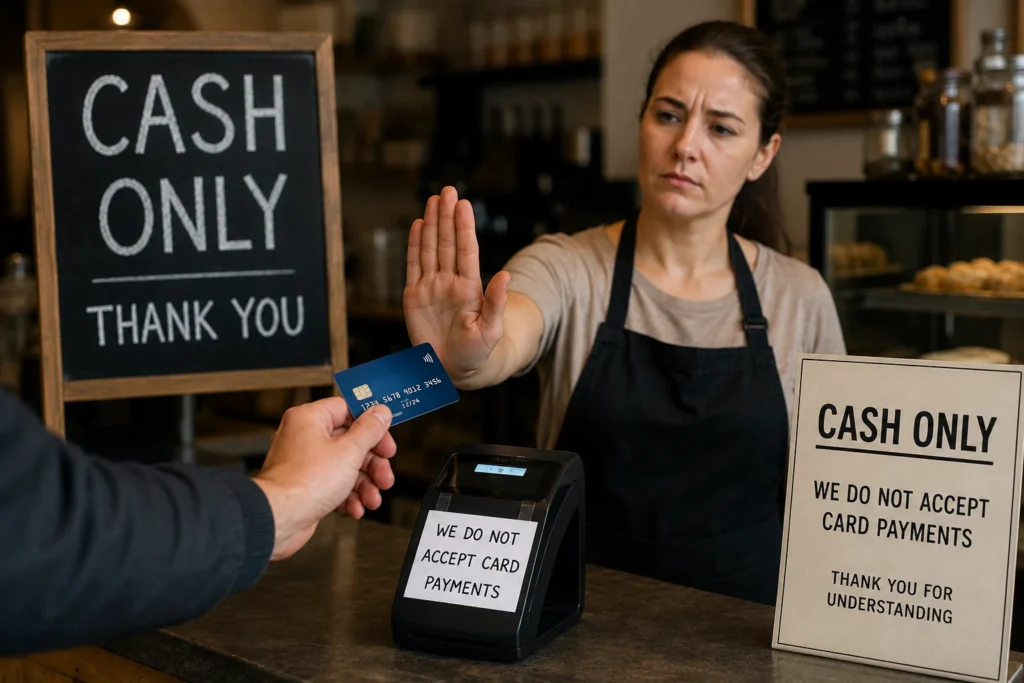
No UK law requires your business to accept card payments. You can legally trade cash-only, card-only, or both. But the practical picture is very different: debit cards now account for more than half of all UK payment transactions (UK Finance, 2024), and cash has dropped below 10% for the first time. The legal question has a quick answer. Whether your current setup is right for you is the more useful one to ask.
LAW Is it a legal requirement to accept card payments in the UK?
No. UK law does not compel businesses to accept card payments. A Treasury written answer to Parliament confirmed this directly: it is the individual merchant’s choice whether to accept or decline any form of payment.
The term “legal tender” is where most of the confusion comes from. It refers to the right to settle a debt in court, not to any obligation on a business to take cards or cash. It has no bearing on how you run your payment policy.
One qualification worth noting: discrimination law. If you run a cash-only or card-only policy, it must be applied consistently. Under the Equality Act 2010, you cannot operate a policy that effectively excludes a protected group, such as older customers who rely on cash. This does not prevent you from going card-only. It means thinking about whether that actually fits your customers.
The rules that catch businesses out relate to how you take cards, not whether you do. You cannot surcharge consumers for paying by card (banned since January 2018). Your provider’s contract will include terms worth reading before you sign. But the basic legal position is clear: you are not required to accept cards.
REALITY Why do some businesses not want to take card payments?
This question deserves a straight answer rather than a dismissal. The three reasons I hear most often are all legitimate.
A £3 coffee takes a real hit on margin when you are paying a processing fee on every tap. The maths looks bad when small-value sales are your main trade. This is a genuine concern, and it is why the right pricing model matters so much. Some card setups are far better suited to high-volume, low-value transactions than others.
I speak to business owners every week who’ve been stung: an 18-month contract they couldn’t exit without a penalty, monthly fees that crept up quietly, or a machine that broke down and took two weeks to replace. If that’s your experience, being reluctant about the next one is completely understandable. The answer is to be more careful about the setup, not to rule out cards entirely.
Cash is immediate. Card settlements typically take one to three business days, and some providers are slower than that. For a business that watches its cash position closely, that lag is real and worth factoring in when choosing a provider.
The honest truth: most resistance to cards is really resistance to a bad setup from a previous bad experience. That is a solvable problem. It is not a reason to turn away 9 in 10 customers who now expect to tap.
Worried your card fees are eating into your margins?
Send Zoe a photo or PDF of your last billing statement and she’ll break down exactly what you’re paying, with zero jargon and zero sales pressure. Most business owners are surprised by what they find.
Get my free statement checkDirect line: 07444 458 367 • Based in Greater Manchester
NUMBERS What does it actually cost to turn card customers away?
What those numbers look like in practice: for every ten customers who walk into your business, roughly one is likely to pay by cash. The other nine expect to tap, chip, or pay by phone.
You will not lose every card customer who can’t pay with you. Some will have cash as a backup. But some will simply leave. A customer who chooses a competitor because you don’t take cards doesn’t complain, doesn’t write a review, and doesn’t appear anywhere on your reports. They just don’t come back. For a cafe, salon, or market stall that runs on repeat custom, that is real money you will never see.
BENEFITS What are the practical advantages of accepting card payments?
The case for cards goes beyond not losing customers. A few specific advantages come up consistently with the businesses I work with.
| Advantage | What it means in practice |
|---|---|
| Higher average spend | Card customers tend to spend more per transaction. When someone can only pay by cash, they buy what the coins in their pocket allow. |
| Tips captured | For hospitality and beauty, a card machine with a tip prompt captures gratuities that cash customers often skip because they don’t have the right change. |
| Record-keeping | Every card sale is logged digitally. VAT returns and year-end reconciliation are much simpler, and you have a clear paper trail if HMRC ever queries anything. |
| Open to everyone | Contactless, chip-and-PIN, Apple Pay, Google Pay: if your machine handles all of them, you never have to turn anyone away. Particularly valuable in busy markets and tourist areas. |
| Faster queues | A contactless tap at £15.86 average (UK Finance, 2024) takes seconds. No counting change, no waiting for the right note. |
The practical value of all of this depends on what you’re paying to access it. If your processing fees are too high for your transaction mix, the advantages shrink. Our guide to understanding card machine fees covers the fee structures to know before you sign anything.
THE FIX What if the problem is your setup rather than cards themselves?
This is where I spend most of my time when someone calls me.
If you’ve had a bad experience (fees that didn’t add up, a machine that didn’t fit how you trade, a contract you couldn’t exit), the temptation is to write off cards entirely. In most cases the issue wasn’t cards. It was the specific provider, the pricing model, or the contract terms, none of which are fixed features of every card machine.
I’ve reviewed statements where a market trader was on a blended-rate contract designed for a fixed retail counter, paying a monthly rental on a machine they could only use on market days. The machine wasn’t wrong because it existed. It was wrong because nobody had matched it to how they actually traded.
The right setup for a high-volume cafe is different from the right setup for a mobile hairdresser or a tradesperson collecting payment on site. Fee structure, contract length, payout speed, connectivity: all of it should reflect how you actually work. Our post on how to tell if your card machine is costing you more than it should gives you a practical starting checklist.
Stop guessing what your card machine is really costing you.
Most providers hook you with a headline rate, then quietly add authorisation fees, PCI charges, and monthly minimums you never agreed to. Send Zoe your last statement and she’ll show you exactly what’s on there, in plain English, with no obligation and no sales pitch.
Get my free statement check
Based in Greater Manchester • Supporting independent UK businesses
Direct line: 07444 458 367
• cardmachinequeen.co.uk
FAQ Frequently asked questions
No. There is no UK law that requires businesses to accept card payments. You can trade cash-only, card-only, or accept both. The choice is entirely yours.
No. Since January 2018, adding a surcharge for consumer card payments has been banned under the Payment Services Regulations. You cannot add any fee because a customer pays by debit or credit card. See our full post on UK card surcharge rules.
Yes, under UK law. But Visa and Mastercard’s own rules ban minimum spend limits, and your provider can fine or suspend your account for repeated breaches. It is a legal option that carries real contractual risk.
No. If you take cards at all, you are not legally required to accept contactless specifically. Most modern terminals support it by default, but your obligation depends on your provider’s setup, not any law.
They cannot pay and you cannot complete the sale. You are under no legal obligation to accept an alternative. The practical implication is a lost sale, and often a lost customer.
This post provides regulatory summaries for small business educational purposes and does not constitute formal legal advice.