
A chair renter normally needs card payments going into their own account, not the salon’s. You can share one salon machine, but only if each person’s takings are kept separate and traceable. HMRC’s May 2025 guidance confirms a common till or card machine is fine, as long as income is separated for each renter. Mixed takings is where salons get caught.
If you rent a chair, or you take rent from chair renters, the way you handle card payments isn’t just an admin choice. Get it wrong and HMRC can decide a “self-employed” stylist is really an employee, with back tax and penalties landing on the salon owner.
The good news is the fix is simple once you know what “separated takings” actually means. Most salons that get caught out aren’t doing anything dishonest. They’ve just set the money up the easy way without realising it muddies the line between two separate businesses.
Below, I’ll show you who should take the payment, when sharing a machine is fine, what HMRC actually said in 2025, and the setup that keeps everyone clean.
👑 Key points at a glance
A chair renter is running their own business, so their client’s payment is their income, not the salon’s.
A card reader is tied to one business and one bank account. It can’t split takings between stylists automatically.
HMRC’s May 2025 guidance says a shared till or card machine is fine, as long as each renter’s income is kept separate.
Pay the renter their full takings first, then collect rent or commission separately. The order matters.
The cheapest reader to buy is rarely the cheapest to run. Most salons are on the wrong setup and have no idea.
Who takes the card payment when you rent a chair?
The renter does, in almost every well-run setup. When a stylist rents a chair, they’re running their own business inside someone else’s premises. Their client’s payment is their income, not the salon’s, so it should reach their account as their money.
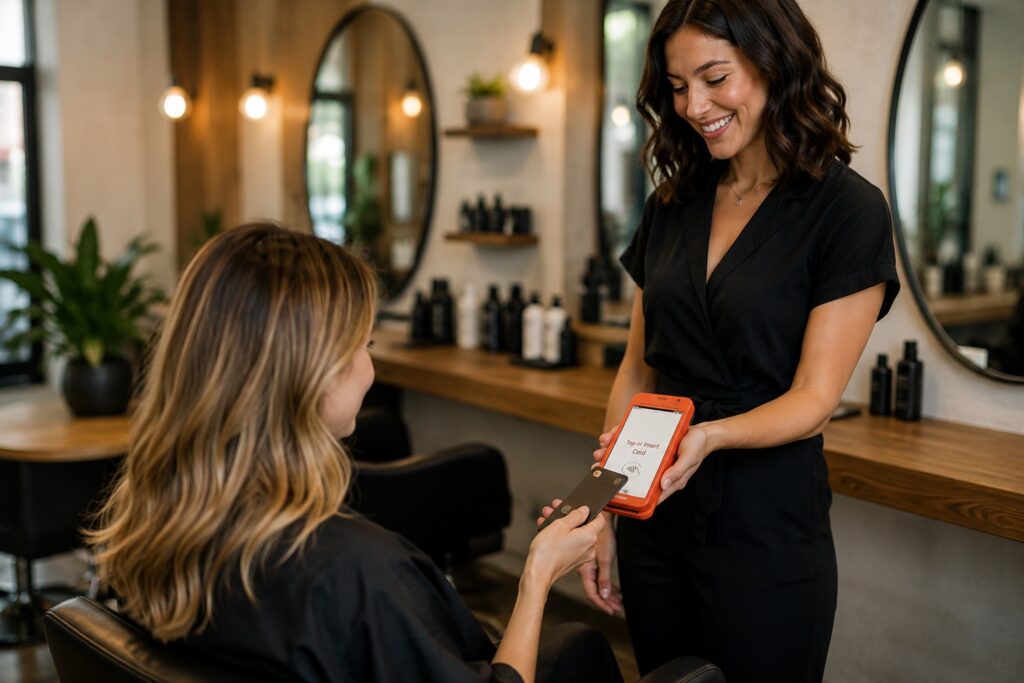
There are two ways this happens in practice. Either the renter has their own card reader, and payments land directly in their own business bank account, or the renter uses the salon’s machine and the salon passes on the takings afterwards. The first is cleaner. The second works, but only if the salon keeps each renter’s money clearly separated and pays it across without skimming rent or commission off the top first.
Do chair renters need their own card machine?
Usually yes, and it’s the simplest way to stay on the right side of HMRC. A card reader is tied to one business and one bank account. It can’t split takings between several stylists and pay each into their own account automatically. So if three renters share one machine, every payment lands in whoever owns that machine, and the money has to be untangled and passed on by hand.
That hand-sorting is exactly where separation breaks down. If a renter’s card income flows through the salon’s account and gets mixed with the salon’s own takings, the paper trail that proves the renter is a separate business starts to disappear. Their own reader, in their own name, paying into their own account, removes the problem at the source.
What does HMRC say about shared tills and card machines?
HMRC’s guidance, published in May 2025 and developed with the National Hair & Beauty Federation, says a common till or card machine isn’t a problem, as long as income is separated for each chair renter. It sits on GOV.UK under “Check employment status if you work in hair and beauty” and was written specifically for the rent-a-chair model.
That word “separated” is doing the heavy lifting. HMRC is watching whether a stylist labelled self-employed is genuinely running their own business or is an employee in disguise. How the money is handled is one of the signals they weigh, alongside who sets the hours, the prices and the client list. If takings are pooled and the salon decides who gets what, that looks like employment. If each renter’s income is tracked and paid to them as their own, that supports self-employment.
The stakes aren’t small. If HMRC reclassifies a renter as an employee, the salon owner can be liable for unpaid PAYE, employer’s National Insurance, holiday pay and more, potentially backdated. This is a tax question your accountant should confirm for your specific setup. What sits in my lane is the payments side: making sure the card setup keeps takings clean rather than muddying them.
Not sure your renters’ takings are properly separated? That’s worth a two-minute call before HMRC ever asks.
Get my setup checkedHow should the salon owner handle the commission split?
Pay the renter their full takings first, then collect rent or commission separately. The order matters. If you take your cut before the money reaches the renter, their card income is running through your business, which is one of the things that weakens their self-employed status.
The cleaner model is the renter receives every payment from their own clients into their own account, then pays you the agreed rent or commission as a separate transaction, ideally against an invoice. It feels like more steps, but it builds the exact paper trail that protects both of you if HMRC ever asks. A percentage-of-takings deal doesn’t have to mean the salon holds the takings.
Which card reader setup is right if you rent a chair?
The right setup depends on whether you want money in your own account, how much you take on card, and whether you work in one spot or move around. It’s not about which reader is cheapest. Here’s how the main situations break down:
✓You want money in your own account from day one. You want a reader tied to your own business and bank account, so nothing routes through the salon’s till. This is the setup that keeps you clean with HMRC, and it’s worth getting the account details right at the start rather than unpicking it later.
✓You do high card turnover. The headline rate and the contract terms start to matter far more than the sticker price of the reader. At real volume, the cheapest self-serve reader is rarely the best-value choice, and the gap adds up over a year. The right pick depends on your actual numbers, which is a quick call rather than a guess.
✓You’re mostly mobile, or quiet some weeks. Flexibility beats features. You want portability, no lock-in so a slow month doesn’t cost you, and tipping that works whether you’re at the chair or on a client’s doorstep.
Why the cheapest card reader is rarely the cheapest to run
The same not-knowing that trips salons up on HMRC trips them up on cost too. The reader most salons reach for is the one that’s cheapest to buy, because it’s the one advertised everywhere and it takes two minutes to order. The catch is that cheap to buy and cheap to run aren’t the same thing, and the gap between them is where salons quietly lose money for years.
A low sticker price often comes with a higher transaction rate, so every payment costs you a little more, every day, indefinitely. Meanwhile there are pay-once machines, and in some cases free ones, that can run on lower rates than the popular pay-as-you-go readers depending on your turnover. They exist, but they’re not marketed at small salons, so most owners never hear about them. Working out which one actually costs you least depends on your turnover and your card mix, and that’s genuinely hard to eyeball. It’s a minefield, and it’s the single most common thing I see salons get wrong. Most salons are on the wrong one and have no idea.
Frequently asked questions
Can two stylists share one card machine and split the payouts?
Not automatically. A reader pays into one account only. You can share a machine, but someone has to separate and pass on each stylist’s takings by hand, and that separation has to be clean enough to satisfy HMRC. Separate readers avoid the problem.
Can a chair renter use tap to pay on their phone instead of a reader?
Yes. Tap to pay on a phone counts as their own card setup, as long as it’s registered to their business and pays into their account. It’s a low-cost option for renters who don’t want hardware, though it’s worth checking it handles tipping and any deposits you take.
Does the salon have to give renters a receipt or invoice for rent?
Good practice, yes. If you charge rent or commission, invoicing the renter for it builds the paper trail that shows two separate businesses. HMRC’s guidance points salon owners toward written agreements and proper records for exactly this reason.
I rent a room, not a chair. Does any of this change?
The payments principle is the same. Whether it’s a room, a chair or a beauty bed, your client income should reach your account as your money, kept separate from the premises owner’s takings.
Is a free card machine a good idea for a chair renter?
It depends, and “free” can mean two very different things. Some free readers carry a higher transaction rate that costs more over a year than a machine you pay for once. Others genuinely run on low rates and are a strong deal, but they’re not the ones advertised at small salons. The only way to know which is which for your setup is to look at the actual numbers.
Not sure your chair-rent payments are set up right?
If you run a salon with chair renters, your card payment setup is part of your HMRC exposure, not just an admin detail. And if you’re the renter, the right reader keeps your money yours and your status clean. Get in touch and Zoe will tell you what fits your situation and keeps your takings separated. Honest, independent, no jargon and no sales pressure.
Get my setup checked