
Card machine fees explained: what UK businesses actually pay

👑 Key points at a glance
Most business owners I speak to know roughly what percentage they pay in card machine fees. Very few can tell me what that percentage is actually made of, or why it is what it is.
That gap matters. If you do not know what the fee covers, you cannot tell whether it is reasonable for your type of business, your card mix, or your monthly turnover. And if you cannot read your statement properly, you will not notice when a new charge appears or when your rates change on renewal.
I audit card machine statements every week, and the same problems come up over and over. This guide breaks down every layer of a card machine fee, covers the charges that appear on top of the headline rate, and tells you what to ask before you commit to any provider.
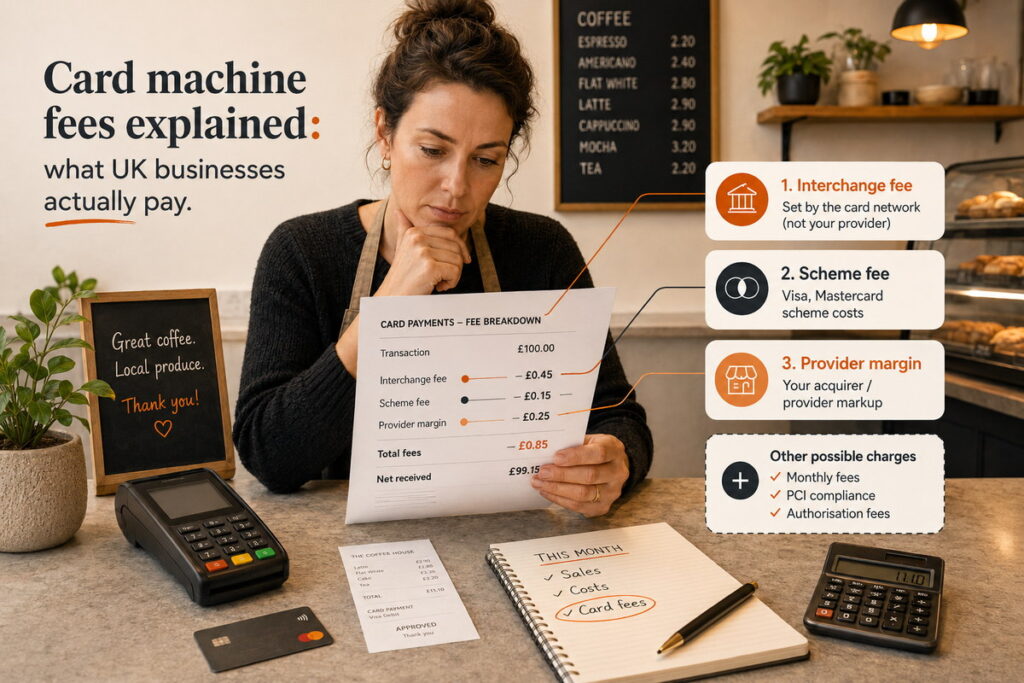
What are the three layers of a card machine fee?
Every time a customer pays by card, three separate costs are created behind the scenes. Most providers bundle them into a single percentage, but they are still three distinct things.
Interchange fee.
This goes to the customer’s bank, the one that issued the card. It covers the bank’s cost of authorising the transaction, managing fraud risk, and moving the funds. For UK consumer debit cards, the interchange fee is capped at 0.2% of the transaction under the UK Interchange Fee Regulation. For UK consumer credit cards, it is capped at 0.3%. Business cards and corporate cards are not subject to those consumer caps, which is one reason some providers charge more when a customer pays with a business credit card.
Scheme fee.
This goes to the card network, either Visa or Mastercard. It covers the cost of running the payment infrastructure: the authorisation network, fraud detection systems, and the rules that make the whole thing work. Scheme fees are small individually but they apply to every transaction.
Acquirer margin.
This is what your payment provider keeps. It covers their hardware costs, customer service, settlement processing, and their own profit. This is the only layer where there is any real variation between providers, and the only layer you can negotiate.
When a provider quotes you a single rate, those three costs are already in it. The question is how transparently they are presented.
What is blended rate pricing, and who is it for?
Blended rate pricing combines interchange, scheme fees, and the provider’s margin into one flat percentage that applies to every transaction. You pay the same rate whether the customer uses a basic debit card or a premium rewards credit card.
It is simple, predictable, and genuinely suitable for most small businesses. If your monthly card turnover is moderate and you want a statement you can read without a spreadsheet, blended pricing is often the right fit. The trade-off is that you cannot see how much of the rate is fixed cost and how much is the provider’s margin, which makes it harder to benchmark or challenge later.
Blended rate is sometimes described as inferior to interchange-plus, but that framing is misleading. For a café taking a few thousand pounds a month on cards, the pricing model matters far less than whether the contract is flexible and whether the provider has decent support. I have seen businesses on blended rates paying less overall than comparable businesses on interchange-plus, once monthly fees are factored in. It depends on your numbers, not the label.
What is interchange-plus pricing?
Interchange-plus (IC++) pricing passes the interchange and scheme fees through at cost and adds the provider’s margin separately, so you can see both on your statement. It is the most transparent structure available.
It tends to suit businesses with higher monthly turnover, where even a small reduction in the provider’s margin makes a meaningful difference over the year, and where the business owner is comfortable reading a more detailed statement.
If your business is growing and you are processing a significant volume each month, ask providers whether IC++ is available. But it is not automatically the right choice, and the headline margin you are quoted still needs scrutinising alongside everything else in the contract.
What other fees appear on a card machine statement?
The transaction rate is usually the largest charge, but it is rarely the only one. These are the ones that catch businesses out most often.
Monthly rental or service fee.
Some providers charge a fixed monthly fee for the terminal or for access to the platform. If you are on a pay-as-you-go reader, there is usually no monthly fee, but the transaction rate tends to be higher. Neither structure is inherently better: it depends on your turnover.
PCI DSS compliance fee.
Payment Card Industry Data Security Standard compliance is a requirement for any business that accepts card payments. Some providers charge a monthly fee for maintaining your compliance status. What I see regularly on client statements is a PCI fee charged even when the business is already fully compliant, with no corresponding service being delivered. Always ask your provider exactly what this fee covers.
Authorisation fee.
A small fixed charge, typically a few pence, applied per transaction on top of the percentage rate. It adds up quickly for businesses with a high volume of low-value transactions. A coffee shop taking thirty card payments before noon pays that authorisation fee thirty times before noon.
Minimum monthly service charge.
Some contracts include a floor: if your card processing fees do not reach a certain level in a given month, you are charged the difference. This catches seasonal businesses and new traders who have a quiet month.
Early termination fee.
Not a monthly charge, but check this before you sign. If you are in a fixed-term contract and want to leave early, providers typically charge the remaining months of fees as a lump sum. On an 18-month contract with ten months to run, that can reach several hundred pounds.
Chargeback fee.
If a customer disputes a transaction and the card issuer reverses the payment, most providers charge you an administration fee on top of losing the sale. The fee applies whether you win or lose the dispute. It is usually a fixed amount per chargeback, and businesses with a high dispute rate can find it adds up quickly.
How do contract terms affect the total cost?
The rate on your statement tells you the cost per transaction. The contract tells you how long you are paying it, and under what conditions it can change.
Card machine contracts in the UK typically run for 12 to 18 months. Some providers offer rolling monthly agreements with no fixed term. Two things in the small print matter more than most business owners realise.
The first is the auto-renewal clause. Many contracts roll over automatically at the end of the term, often with a notice period of 30 to 90 days required to cancel. Miss that window and you are committed for another full term. I reviewed a pub landlord’s contract last year and found three separate charges that were not in the original quote, all added at the first renewal with no explanation. The second is the rate change clause: some contracts allow the provider to adjust rates with notice, and that notice period can be shorter than you expect.
If you want to understand your current contract before it renews, get in touch and I will go through it with you at no cost.
Does the type of card affect what I pay?
Yes, and blended rate pricing obscures this. The cost of processing a basic consumer debit card is lower than the cost of processing a premium rewards credit card or a corporate card. Under blended pricing, you pay the same rate for both. Under IC++, the difference shows up on your statement.
This matters most for businesses whose customers tend to pay with premium or business cards: higher-end hospitality, specialist retail, B2B services. If that describes your customer base, get a breakdown of your card mix before you compare pricing models.
Business cards are worth a specific mention. Because interchange on business cards is not capped the way consumer card interchange is, some providers charge a noticeably higher rate when a customer pays with a business credit or charge card. If you take a lot of business card payments, ask any provider you are considering how they handle those transactions.
What should I look for when comparing providers?
Transaction rate is one factor. These are the others that tend to matter more in practice.
Contract length and exit terms.
A lower rate on an 18-month contract is not always better than a slightly higher rate on a rolling monthly agreement, particularly if your business is likely to change in the next year.
Settlement speed.
When does the money from today’s sales actually reach your bank account? Next-day settlement is standard with most providers now, but not universal. For cash-flow-sensitive businesses, this matters.
Hardware fit.
Does the machine do what you actually need: portable, countertop, integrated with your till, capable of taking tips? A machine that does not fit how you work is a problem regardless of the rate.
Support.
If your card machine goes down on a busy Saturday, who do you call and what is the realistic response time?
All of those factors interact, and the right combination depends on how your business trades. If your current setup has any of the warning signs, a statement check with me takes ten minutes and tells you clearly where you stand. You can also read how to tell if your card machine is costing you more than it should.
Frequently asked questions about card machine fees
Are card machine fees tax deductible?
Yes. Card processing fees are a legitimate business expense and are deductible against your taxable income. Keep your monthly statements so the figures are easy to locate at year end. Your accountant can confirm how they should be categorised.
Can I pass card fees on to my customers?
No. Surcharging customers for paying by card has been prohibited in the UK since January 2018 under the Payment Services Regulations. You cannot add a fee at the point of sale for card payments. You can set a minimum spend, though separate rules apply to that. I have written a full breakdown of UK card surcharge rules and the minimum spend question.
What is a merchant service charge?
Merchant service charge (MSC) is the term some providers and older contracts use for the overall cost of accepting card payments, usually expressed as a percentage of turnover. It is effectively another name for the blended rate: interchange, scheme fees, and the provider’s margin combined into one figure.
Why does my statement show different rates for different transactions?
If you are on IC++ pricing, you will see interchange and scheme fees vary by card type, with the provider’s margin added separately. If you are on blended pricing and still see variation, check whether you are being charged differently for credit versus debit, or for in-person versus card-not-present transactions. If anything is not explained clearly, ask your provider to itemise it.
What happens to my fees when my contract renews?
That depends on your contract terms. Some providers hold the rate for the new term. Others reserve the right to reprice on renewal. The notice period for opting out of a renewal is often buried in the small print, and missing it means you commit to another full term at whatever rate the provider proposes. Set a calendar reminder two months before your contract end date.
Do fees differ for contactless and chip-and-PIN payments?
Generally not for in-person transactions, whether the customer taps or inserts the card. The distinction that affects fees is in-person versus card-not-present (payments taken by phone or online), where some providers charge a different rate because the fraud risk is higher.