
Written by
Zoe Bordiuk, Independent Payment Consultant
Honest card payment guidance for UK small businesses. Last updated: 16/07/2026
I get asked this question most weeks: what is the best card machine for a café. The honest answer is that there is no single winner. There is a right fit for how your café actually runs, and a wrong fit that quietly costs you queue time, cash flow, or staff goodwill. Below is what I actually check when a café owner calls me, in the order I check it.
I am not going to quote you transaction rates here. Every café’s card mix and volume is different, and the number that matters is your effective rate, not a headline percentage on a website. That is a two minute conversation, not a blog post. What I can do here is walk you through everything else that decides whether a machine actually works for your café.
👑 Key points at a glance
What actually decides the right card machine for your café?
Three things, in this order: how you serve customers, how many transactions you take at peak, and whether your Wi-Fi is reliable enough to trust. A busy counter café doing a hundred and fifty small transactions between eight and ten in the morning needs a device that will not lag on the third flat white in a row. A café doing table service needs a printer built in or attached, because walking back to a till for every receipt slows the whole room down.
I have set up card machines for clients where the owner picked the terminal with the most features and regretted it within a month, because the screen was too small for tired morning eyes and the battery did not survive a Saturday shift. Match the device to your actual service pattern first. Everything else is secondary.
Countertop, portable, or both?
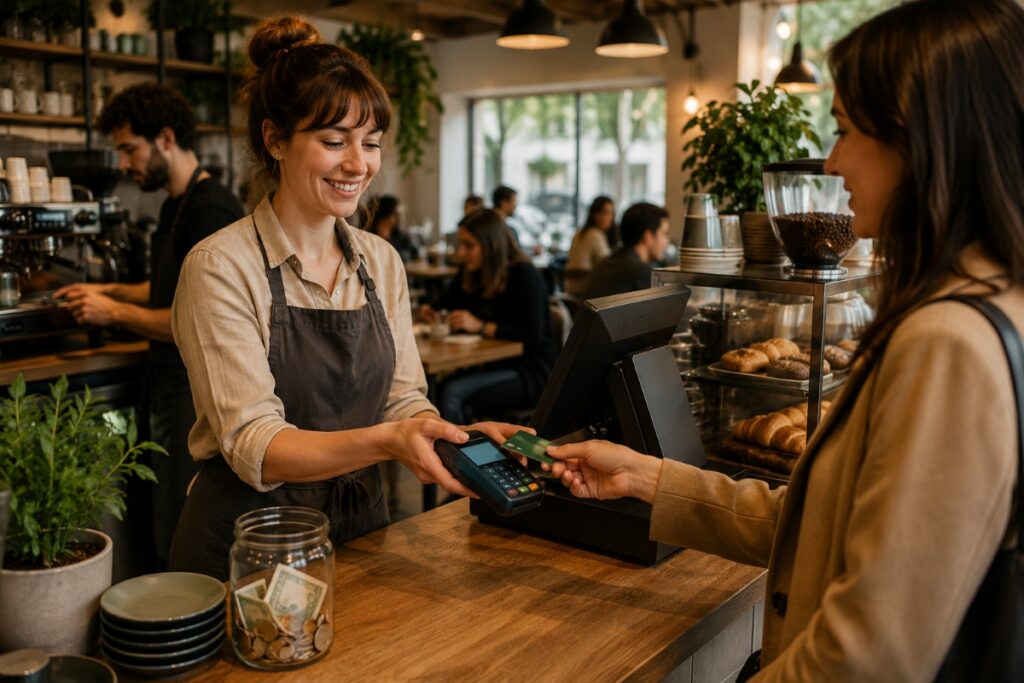
A countertop terminal, wired in and always powered, suits a café where every transaction happens at the till. There is no battery to worry about and no chance of it walking off. A portable or handheld device suits table service, or a counter that also wants to take payment on the shop floor during busy periods.
Many of the cafés I work with end up with one of each: a fixed unit at the till for speed, and a portable one for table service or overflow queuing at peak times. It is not an either or decision if your layout genuinely needs both.
How fast will the money actually land in your account?
Settlement typically lands within one to three working days, though the exact timing depends on your specific provider and account setup. For a café running tight on weekly wage and stock payments, the difference between next day and three days can be the difference between paying suppliers on time and juggling.
Ask this directly before you sign anything: what day will Friday’s takings actually show up in the account. Not the marketing answer. The real one, including bank holidays and weekends.
Does your card machine affect how much your staff keep in tips?
Yes, and this is the part almost nobody mentions when they talk you through terminals. Since October 2024, the Employment (Allocation of Tips) Act 2023 has required employers in England, Scotland and Wales to pass on qualifying tips, gratuities and service charges to workers in full, with no deductions beyond tax and any National Insurance that is legally due.
That includes card processing costs. If a customer taps a card tip on your machine, the requirement to pass on the full tip means you cannot take the processing fee out before it reaches your staff. You absorb it. For a café with a healthy card tip culture, that is a real, ongoing cost sitting quietly on top of whatever your machine charges you for the transaction itself, and it is worth factoring in when you weigh up providers rather than discovering it later on a payroll query.
I have sat with café owners who assumed the tip amount that hit the till was the tip amount their staff received, minus the usual admin. It is not. The rule exists to stop exactly that assumption, and it is one more reason to know your true costs rather than guess at them.
What contract length actually suits a small café?
Some providers lock you in for eighteen months with an exit fee if you leave early. Others run on a rolling monthly basis with no penalty for walking away. Neither is automatically better. An eighteen month term can suit a café with settled, predictable trade and a good rate locked in. A rolling contract suits a newer café, or one still working out its real card volume, because it leaves the door open if your circumstances change.
Read the exit clause before you read the feature list. That is the one part of the paperwork that actually bites if things do not go to plan.
What happens if it goes down on a Saturday morning?
Some providers only offer support Monday to Friday during office hours. For a café trading its busiest hours on a Saturday or Sunday, that is close to useless if the terminal freezes mid queue. Ask specifically about weekend and out of hours support before you commit, not after.
Comparing what actually matters, side by side
👑 Not sure which setup actually fits your café?
I will look at how your café actually runs (counter, table service, or both) and tell you straight what fits and what to avoid. Unlike most card machine sales reps, who can only offer you the one provider they work for, I work across several, so the recommendation is about your café, not about which door you happened to knock on.